
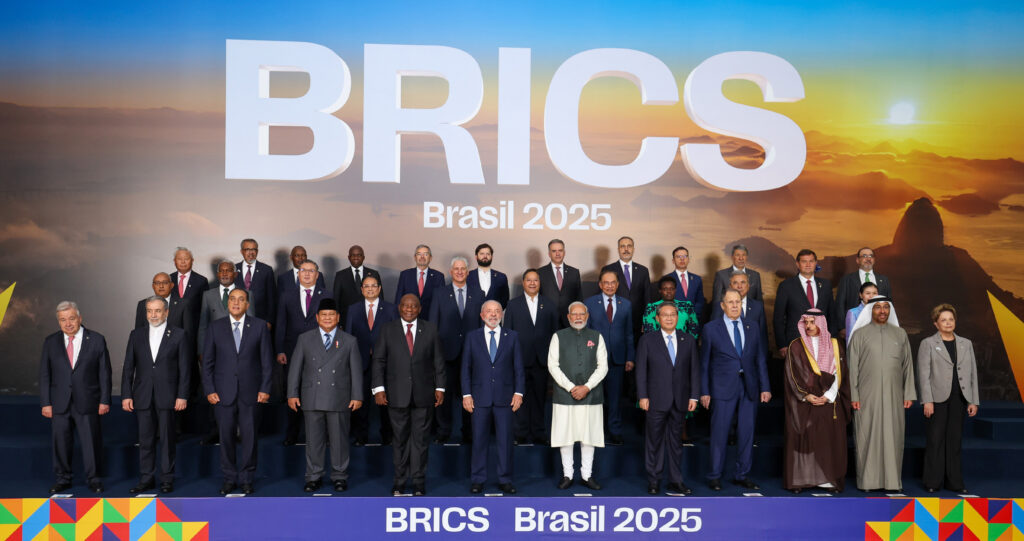
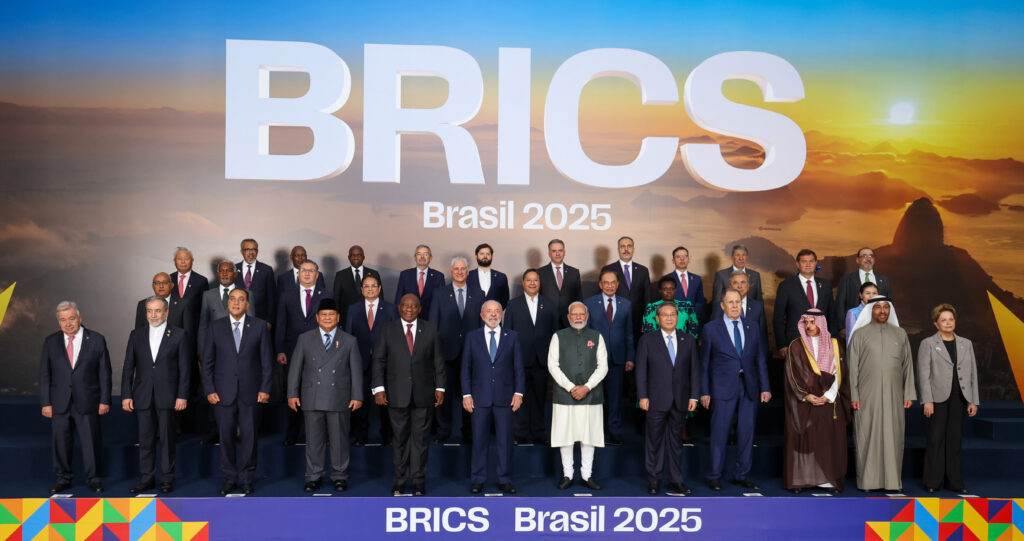
The vibrant city of Rio De Janeiro has braced to host the high profile summit of Global South leaders under the BRICS+ bloc on July 6th and & 7th. The summit was hosted by Brazilian President Lula and was attended by the Indian PM Narendra Modi, Chinese Prime Minister Li Kiang, Russian Foreign Minister Sergei Lavrov among other leaders.
BRICS+ 2025 Highlights
The leaders of the BRICS+ have adopted a strong joint declaration condemning the air strikes over Iran (recently added member) by Israel and US, called them illegal and against the UN charter. The countries went on to criticize the anti trade policies, using tariffs as trade blocks, restrictive trade practices, and unilateral tariff imposition, indirectly aiming at the President Trump, but fell short of naming him directly.
The member countries have also agreed to pursue channels and methods to create an alternate payment mechanisms, enhance cooperation on renewable and green energy, enhance institutions to create a credible alternative to Western-led Institutions like World Bank, IMF etc.
President Trump’s Tariff Threat
Since assuming office, President Trump has made trade tariffs his most powerful foreign policy tool, frequently using them to pressure countries and assert American dominance to further his foreign policy agenda. He has long termed the bloc as anti-American, working to undermine American interests and its role.
Previously, when there was a talk on de-dollarisation, Trump has threatened to impose 100% tariffs on goods imported from the countries which are going to pursue de-dollarisation. Now, he has declared that all the countries associated in any way with BRICS+ grouping will have to pay an additional 10% tariff, with no exceptions. https://truthsocial.com/@realDonaldTrump/114809574296066307
India’s Needs with BRICS+ and the US
India is a founding member of the BRICS+ bloc. It has long aimed at positioning itself as the responsible leader of the Global South voicing concerns impacting the emerging economies. It wants to become a leader representing the Global South at international forums, build and support better trade, economic, technological ties between the partner countries.
US is one the largest trading partners of India, and one of the few economies it runs a trade surplus with. After assuming office, President Trump unilaterally imposed sweeping tariffs on many countries, he levied a tariff rate of 26% on India, including the basic customs duty of 10%. Though the implementation of tariffs were postponed, India and US entered into trade talks to reach a Bilateral Trade Agreement (BTA). India and US have held multiple high delegation discussions to strike a deal.
India’s Balancing Act and Strategy
Now, that Trump is at loggerheads with BRICS+, India will have to walk a diplomatic tight rope. India wants to take a slice of global supply chain restructuring forced by Trump’s tariff and China+1 policy. It wants to strike a trade deal with US, to better position it as an attractive manufacturing and investment destination for global companies. Low tariffs, better US market access, predictable policies enabled by India-US BTA can nudge global companies setup their manufacturing units in India.
On the other hand, India wants to enhance its global standing by representing itself as the ‘Voice of the Global South’. It plans to enhance trade ties, technological, defence, and agricultural cooperation with the countries in Africa, the Middle East, South, and Latin America. Historically, India’s foreign policy doctrine is based on “Strategic Autonomy”, and it thinks aligning itself with the emerging countries to further its interests, collaboration on similar concerns, along with establishing good relations with Western countries to gain access to their huge markets, cutting edge technology and investments is key to its growth and security.
So, the path that India has chosen to participate with full vigour in BRICS+ Summit, voicing their collective issues on international platforms, and aligning with Western countries for its investment, defence and security needs is the way forward. It needs to walk the path very carefully, handling the differences between the BRICS+ and the US delicately. Any misstep or clear alignment with one side can lead to distrust and pose a threat to India’s growing role and its interests.
In the end, India’s diplomacy will not be measured by whose side it chooses, but by how well it can avoid choosing sides at all.